
I've watched many technology waves wash over the enterprise world.
Client-server.
Internet.
Cloud.
Mobile.
Each one came with a familiar pattern: early adopters gained an edge, skeptics rationalized delay, and laggards scrambled to catch up — or didn't.
AI is different. Not because the hype is louder (it is), but because the pace of change has become genuinely unprecedented — even by the standards of someone who's lived through every major shift of the past four and a half decades.
Let me be direct with you: if your organization does not have an AI strategy today, you are already behind. Not hypothetically. Operationally.
What Just Happened in the Last Few Months
The velocity alone should give every executive pause. Consider what has occurred in just the past 90 days:
OpenAI, Anthropic, Google, and Microsoft have each released or announced model upgrades that made the prior generation feel like legacy technology — not over years, but over weeks. Agentic AI — systems that don't just answer questions but plan, execute, and iterate on multi-step tasks autonomously — has moved from research concept to production deployment across legal, finance, software development, and customer operations.
The cost of intelligence has plummeted. What required expensive infrastructure and specialized teams 18 months ago can now be deployed via API for fractions of a cent per query. Enterprise AI is no longer a capital-intensive bet; it's a utility.
Meanwhile, the workforce is not waiting for corporate policy to catch up. Your employees are already using AI tools — with or without your blessing, your governance, or your security review. In my advisory work, I consistently find that AI adoption within organizations is running 3 to 6 months ahead of where IT and leadership believe it is.

The Benefits of Moving Now: Real Examples
Productivity and Throughput
Companies that have deployed AI-assisted workflows in software development (GitHub Copilot and its competitors) are reporting 30–50% reductions in time to first working draft of code. Legal firms using AI for document review are completing due diligence in days that previously required weeks. These aren't pilot results — they're production outcomes.
Decision Velocity
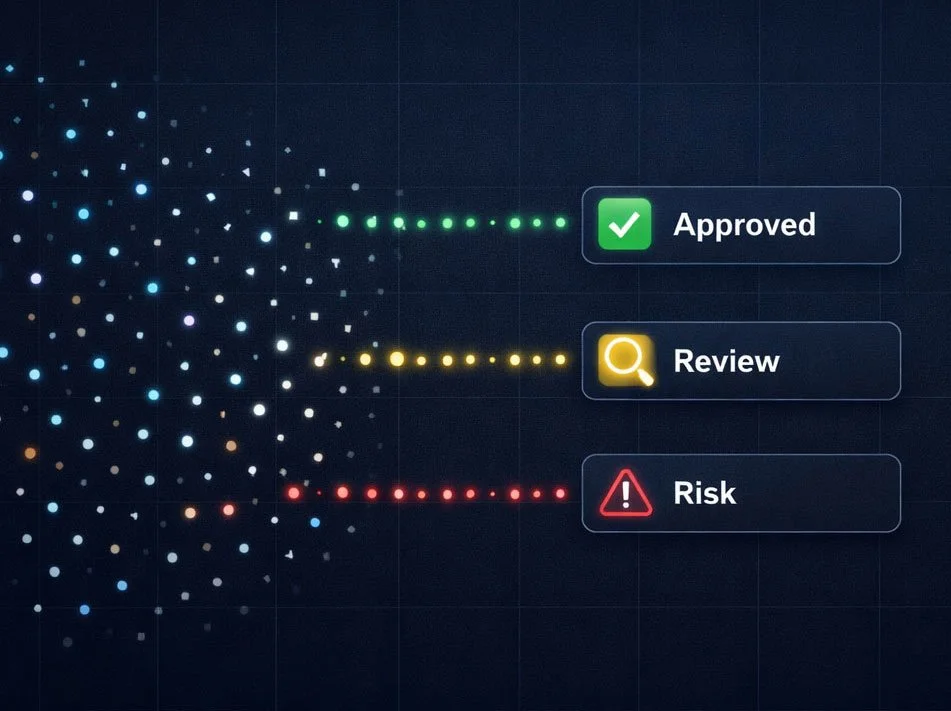
A mid-market manufacturing client deployed an AI layer over their ERP data and unstructured procurement documents. Within 90 days, their supply chain team was surfacing risk signals and vendor anomalies that previously took a senior analyst two days to compile. The same insights now appear in a morning briefing, automatically. Decisions that lagged on waiting for data are now made same-day.
Customer Experience at Scale
Retailers and financial services firms are using AI to deliver personalized, contextually aware customer interactions at a scale no human team could match. Not chatbots in the 2018 sense — systems that understand context, history, intent, and can escalate intelligently. Customer satisfaction scores are moving. Churn is moving. Revenue is moving.
Competitive Intelligence and Market Sensing
Organizations using AI to monitor competitive signals, regulatory shifts, and market sentiment are operating with a situational awareness advantage that compounds over time. The longer you build that capability, the more calibrated and valuable it becomes.
The Risks of Not Having a Strategy
This is where I want to be blunt, because I've seen the consequences firsthand across multiple technology cycles.
The Talent Signal You're Sending
Top technical talent evaluates potential employers on the sophistication of their technology environment. If your organization's answer to "what's your AI strategy?" is "we're still evaluating," you are losing recruits to competitors who can articulate a vision. The best engineers, analysts, and product managers want to work with modern tools. This gap will widen, not narrow.
The Productivity Gap Becomes Structural
If your competitors are compressing a 10-hour analytical task to 45 minutes and you're still doing it manually, that's not an efficiency gap — it's a structural cost disadvantage. Over time, it reprices what you can charge, what margins you can sustain, and what headcount you require. The compounding effect of this gap is severe.

Shadow AI Is Already Happening
Your people are already using ChatGPT, Claude, Copilot, Gemini, and a dozen other tools on their personal devices and browsers — often with company data pasted directly into them. Without a governance framework, you have no visibility, no data controls, and no audit trail. The risk here is not theoretical. It is happening now, in your organization, regardless of whether a policy exists.
The Regulatory Window Is Closing
The EU AI Act is in force. The United States is actively developing sector-specific AI guidance. Healthcare, financial services, and federal contractors are already seeing AI-specific requirements emerge in contracts and compliance frameworks. Organizations building AI governance now will have documentation, controls, and institutional muscle memory when auditors arrive. Those who haven't started will be building governance under duress — the most expensive and error-prone way to do it.
First-Mover Advantages Are Compounding
AI systems improve with use. Organizations that have been training custom models, building fine-tuned workflows, and accumulating proprietary data pipelines are establishing leads that late adopters cannot easily close with off-the-shelf solutions. The longer you wait, the more you are buying someone else's repackaged advantage rather than building your own.
What an AI Strategy Actually Requires
STG helps organizations across sectors build these frameworks. The ones that succeed share a few common characteristics.

They start with use-case clarity — not "AI in general" but specific, high-value workflows where AI can compress time, reduce errors, or unlock scale. Prioritize by ROI and feasibility, not novelty.
They build governance in parallel with deployment — data classification, acceptable use policies, vendor security assessments, and human-in-the-loop controls are not obstacles to AI adoption; they are the infrastructure that enables sustained adoption.
They invest in change management — the limiting factor in almost every AI deployment I have seen is not the technology; it is the organizational readiness to work differently. Training, communication, and leadership modeling are non-negotiable.
They measure outcomes, not activity — the question is not "how many AI tools are we licensed for" but "what has changed in our operational metrics, decision velocity, or customer outcomes."
And critically — they treat AI strategy as a living capability, not a one-time project. The organizations that will thrive are those that build the institutional muscle to evaluate, adopt, and govern new AI capabilities on an ongoing basis, because the landscape will continue to evolve faster than any static plan can anticipate.
The Bottom Line
Four decades in this industry has given me a reliable filter for separating genuine platform shifts from expensive distractions. AI is the former — and unlike prior waves, it is moving at a pace where the window between "early adopter" and "catching up" is measured in months, not years.
Every organization — regardless of sector, size, or technical maturity — needs three things right now:
An honest assessment of where AI is already being used inside the business (with or without sanction)
A prioritized roadmap of where structured adoption creates the most value
A governance framework that allows you to move fast without creating unacceptable risk
If you don't have those three things, that's not a technology problem. It's a leadership priority.
The good news: it's not too late to move. But the window for "deliberate early adoption" is closing. What comes next is reactive catch-up — and that's always more expensive.
STG works with leadership teams across industries to accelerate technology decisions — including AI strategy and governance. If this resonates with challenges you're navigating, we’d welcome the conversation.