Voice Biometrics and the Future of Customer Authentication
Customer experience can start breaking down before the real conversation even begins.
A customer calls because they need help. Maybe there is a billing issue, a delayed order, a denied claim, a fraud alert, or an account access problem. Before they can explain what happened, they often have to prove who they are.
That can mean confirming personal details, answering security questions, waiting for a one-time code, or repeating information they already provided.
Each step may seem reasonable on its own. Together, those steps can make the experience feel slow before anyone has started solving the actual issue.
That’s one reason voice biometrics is becoming part of the CX AI conversation.

Authentication Is Part of the Customer Experience
Most organizations treat authentication as a security function. That makes sense. Protecting customer accounts, sensitive information, and regulated data is essential.
But in a contact-center environment, authentication also shapes the customer experience.
A long or repetitive verification process can affect the tone of the entire interaction. Customers may already be frustrated when they call. Adding more steps before they can get help can make the situation worse.
For agents, authentication also takes time away from the work customers actually care about. Instead of getting directly into the issue, agents may spend the first part of the call confirming identity, asking routine questions, or waiting for verification steps to complete.
Across thousands or millions of interactions, that time adds up.
Authentication can influence:
Average handle time
Call abandonment
Agent workload
Customer satisfaction
Overall service cost
For contact centers looking to improve performance, authentication is a practical place to look. It is familiar, measurable, and often more frustrating than organizations realize.
What Voice Biometrics Does
Voice biometrics uses a person’s voice characteristics to help verify identity.
Instead of relying only on knowledge-based questions, such as account numbers or security answers, voice biometrics can analyze speech patterns and compare them to an enrolled voiceprint.
In many cases, verification can happen while the customer is already speaking naturally.
That is the key difference.
The customer does not have to stop the conversation to complete a separate security process. The interaction can move forward with less disruption.
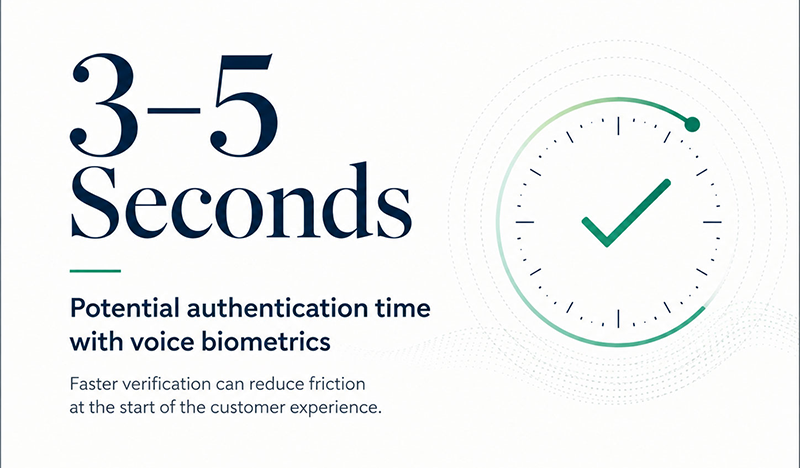
Rather than spending the first part of a call confirming multiple personal details, the system may be able to verify identity during the first few moments of normal speech. The agent can then focus more quickly on the customer’s actual need.
Want the full CX AI analysis? Download From Hold Music to Hello for platform insights, ROI benchmarks, and practical evaluation guidance.
Less Time Verifying. More Time Helping.
For customers, the benefit is simple. They want to get help faster.
Most people do not think about authentication as a separate part of the service experience. They just know the call feels easier or harder depending on how many steps they have to complete.
A smoother authentication process can make the beginning of the interaction feel more natural.
That matters because the first part of a customer-service interaction often sets the tone for everything that follows.
If customers spend the first minute answering questions, repeating information, or waiting for codes, the experience starts with frustration. If they can be verified quickly and move into the actual issue, the conversation feels more productive.
Voice biometrics can also benefit agents. When verification takes less time, agents can spend more of the call listening, problem-solving, and resolving the issue.
Security Still Comes First
Voice biometrics should not be viewed only as a convenience tool. It also plays an important role in security.
Traditional authentication methods often rely on information that can be stolen, guessed, or socially engineered. Customers may reuse passwords, share personal information across many sites, or unknowingly expose data through breaches.
Voice biometrics adds another layer to the authentication process by using something more personal and harder to replicate: the customer’s voice.
That does not eliminate the need for strong governance, privacy practices, consent, and fraud controls. Organizations still need to evaluate these solutions carefully, especially in regulated industries.
But for many contact centers, voice biometrics offers a way to improve both security and customer experience in the same part of the journey.
Where Voice Biometrics Fits Into CX AI
Voice biometrics is one piece of a larger customer experience strategy.
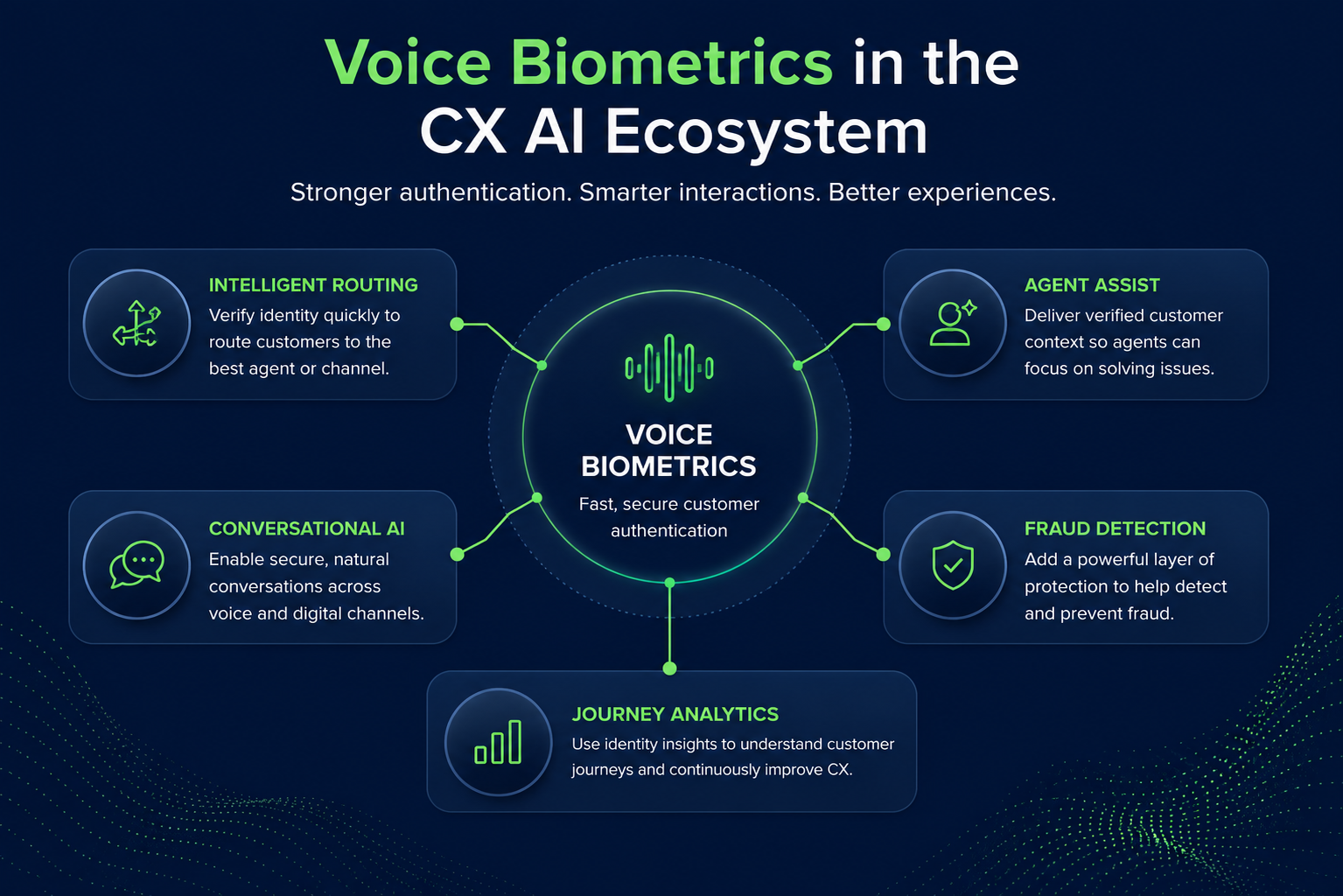
It often works alongside other CX AI capabilities, including intelligent routing, conversational AI, agent assist tools, fraud detection, and customer journey analytics.
The value increases when these technologies work together.
A customer who is verified quickly can be routed more intelligently. An agent who receives context earlier can handle the interaction more effectively. A conversational AI agent with secure authentication can resolve more routine issues without forcing the customer through unnecessary steps.
The goal is to remove friction from the customer journey.
What Organizations Should Consider
Voice biometrics can create value, but it should be evaluated with care.
Before adopting any authentication technology, organizations should consider:
Where customers experience the most verification friction
How authentication affects call time and satisfaction
How consent and privacy will be handled
How the solution integrates with existing systems
How exceptions, failed matches, and escalations will work
How performance will be measured after deployment
The best use cases are often found in high-volume environments where customers call frequently and verification takes meaningful time.
A Small Step That Can Change the Whole Call
Voice biometrics may sound like a narrow technology category, but the experience it affects is not small.
Authentication happens at the beginning of the interaction, when the customer is forming an impression of how easy or difficult the process will be.
If that first step is slow, repetitive, or frustrating, the rest of the conversation has to recover from it.
If that first step is fast and natural, the customer and agent can get to the real issue sooner.
For organizations evaluating CX AI, this is one of the areas worth a closer look. Some of the biggest gains may come from improving the parts of the customer journey that have been accepted as normal for too long.
Want the Full Analysis?
Scien Tech Group’s CX AI position paper, From Hold Music to Hello, explores the technologies, outcomes, platform categories, and evaluation criteria shaping the next generation of customer experience.
Access a vendor-neutral analysis of the technologies, outcomes, and evaluation criteria shaping the next generation of customer experience.