As AI Takes the Easy Calls, What Happens to the Human Agent?
For years, one of the biggest promises of contact center AI has been the ability to automate routine interactions and reduce the amount of work that needs to reach a human agent. That transition is already changing the makeup of the conversations agents handle.
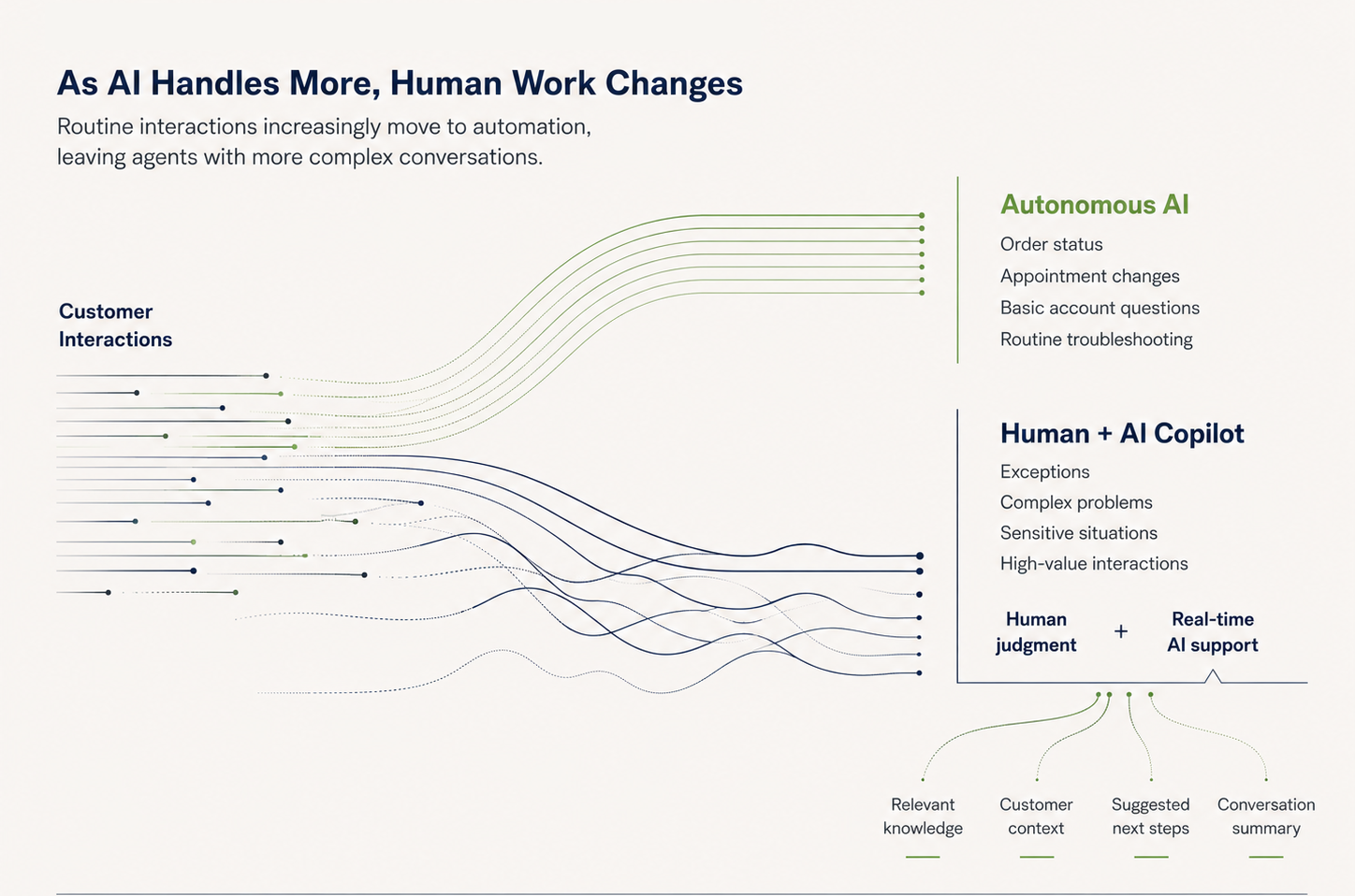
Account questions, appointment changes, order status, basic troubleshooting, authentication, and other predictable interactions are increasingly strong candidates for automation. As more of those interactions move to AI, human agents are left with a higher concentration of issues that require judgment, context, empathy, and problem-solving.
The result is a different kind of contact center job. Agents increasingly serve as escalation points for the conversations that are difficult to automate, and they need technology designed for that reality.

The Agent’s Job Is Getting More Complex
Consider what happens when AI successfully handles a large share of routine customer interactions. The conversations that reach an agent are more likely to involve unusual problems, frustrated customers, complicated account histories, exceptions to standard policies, high-value interactions, or situations involving several systems and departments.
At the same time, agents are still expected to navigate multiple applications, search knowledge bases, interpret policies, document interactions, and make decisions while carrying on a conversation with the customer. As the complexity of agent-handled interactions rises, those demands become harder to manage consistently.
This shift has implications across the contact center. Training, quality management, workforce planning, knowledge management, and the agent desktop all need to evolve along with the work.
AI Agent Assist Brings Support Into the Conversation
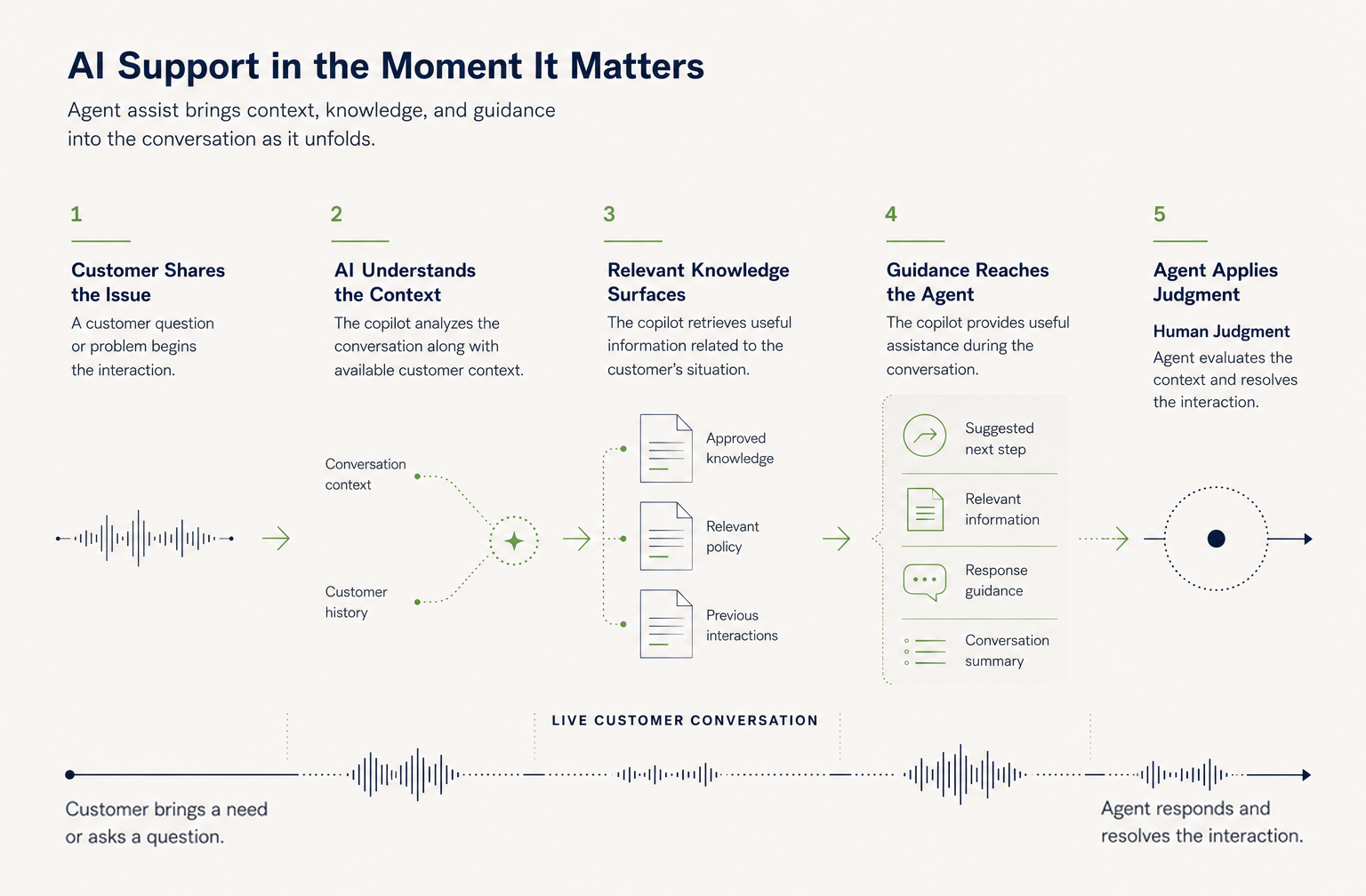
Agent-assist technology uses AI alongside the employee during a live customer interaction. It can analyze the conversation, understand context, retrieve relevant information, suggest next steps, surface knowledge, and summarize details as the interaction unfolds.
This gives the agent immediate access to information and guidance without requiring them to continually leave the conversation to search for it. The employee can devote more attention to understanding the customer, evaluating the situation, and making the decisions that require human judgment.
The From Pilot to Program position paper describes a three-layer contact center model emerging in 2026: autonomous AI handling a significant portion of volume, AI copilots assisting human agents with the interactions that remain, and escalation paths for genuinely complex cases.
For CX leaders, that model expands the conversation around AI productivity. There is value to capture inside the interactions that continue to require people.
Give Agents the Right Information at the Right Time
Traditional knowledge management puts much of the search process on the agent. A customer asks a question, the agent searches, reviews the results, opens an article, finds the relevant information, interprets it, and returns to the conversation. Each additional step takes time and creates another opportunity for inconsistency.
AI agent assist can surface relevant information while the conversation is still unfolding. A copilot might bring up a policy when a specific issue arises, suggest a troubleshooting step based on what the customer has already tried, or retrieve information grounded in the organization’s approved knowledge sources.
This becomes increasingly valuable as products, policies, regulations, and internal information change. Employees have better context at the moment a decision needs to be made, with less time spent searching across multiple systems.
Help More Agents Perform Like Experienced Agents
Every contact center has a gap between its most experienced agents and employees who are still developing their skills. Experienced agents recognize patterns, know where to look for information, understand which questions to ask, and have encountered enough unusual situations to navigate them with confidence.
AI copilots can make more of that organizational knowledge accessible across the workforce. Real-time guidance can help newer agents navigate unfamiliar situations while giving experienced employees faster access to information they might otherwise need to track down manually.
There are implications for onboarding as well. Instead of relying heavily on an agent’s ability to memorize large amounts of information before handling difficult conversations, organizations can provide support while employees build experience on the job. Human expertise remains central to the interaction, with AI helping employees access and apply the organization’s collective knowledge more consistently.
The Productivity Opportunity Is Already Visible
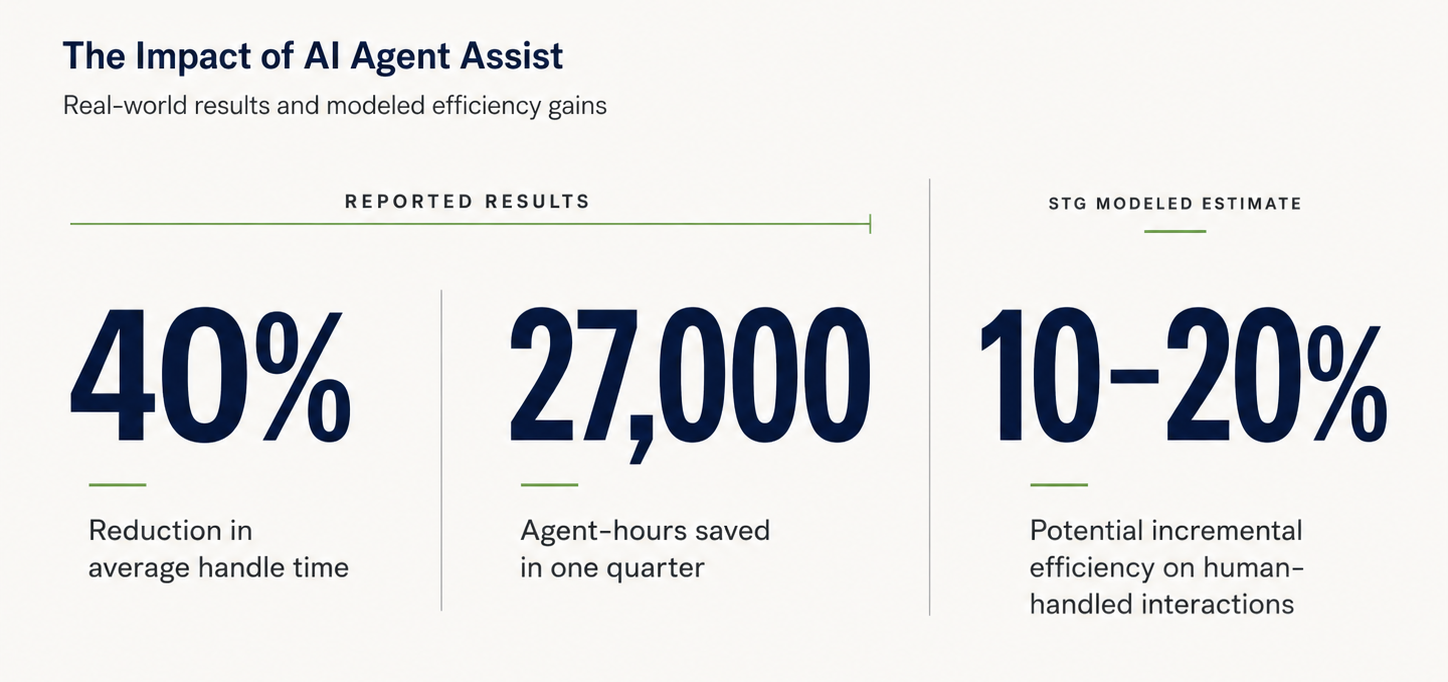
Documented agent-assist deployments cited in From Pilot to Program have reported average handle-time reductions of as much as 40%, along with measurable improvements in first-call resolution and customer satisfaction. One AI-assisted chat deployment reported saving 27,000 agent-hours in a single quarter.
Scien Tech Group’s analysis also points to additional efficiency after the core CX AI platform is already in place. Adding conversation intelligence and agent assist can produce approximately 10–20% in incremental efficiency on interactions that continue to be handled by humans, without increasing headcount.
Results will vary based on the organization, use case, implementation, and existing technology environment. Still, these examples illustrate an important opportunity for CX leaders: customer-facing automation and employee-facing AI can contribute to productivity in different parts of the same customer journey.
Agent Assist Depends on Strong Knowledge
The quality of an AI copilot’s guidance depends heavily on the information available to it. Enterprise knowledge grounding therefore becomes an important part of any agent-assist strategy.
Retrieval-augmented generation, or RAG, allows AI systems to ground responses in indexed, permissioned enterprise content. The architecture behind that retrieval needs to account for workflows, compliance requirements, permissions, relevance, and scale.
Agents experience the result of those decisions in a much simpler way. They need accurate information that is appropriate for the customer and situation, delivered quickly enough to be useful during the conversation. Achieving that experience requires coordination across knowledge management, integrations, governance, and the systems supplying AI with context.
Adoption Deserves Just as Much Attention as Technology
Even a capable agent-assist platform will struggle to deliver results when employees do not trust it or find it disruptive. Introducing AI into the agent desktop also raises understandable questions about how the technology will be used and how employee performance will be evaluated.
The position paper identifies agent adoption, trust, and change management as important considerations when evaluating agent-assist technology. Organizations need to communicate how the system works, where its information comes from, how recommendations should be used, and where human judgment remains essential.
The employee experience should be part of implementation planning early in the process. A copilot that saves time, reduces unnecessary searching, and helps agents navigate difficult conversations has a much stronger case for adoption than one that simply adds another layer to the desktop.
Rethinking What AI Success Looks Like
Automation rates and cost reduction will continue to be important measures of contact center AI performance. The changing mix of human-handled conversations makes another set of outcomes increasingly significant: how effectively agents resolve difficult issues, how consistently they perform, and how well they handle the interactions that matter most to customers.
A smaller pool of agent-handled conversations may contain a disproportionate share of the interactions that influence loyalty, retention, revenue, and customer perception. Giving employees better information and support during those moments can become a meaningful part of the business case for AI.
As organizations plan the next stage of their CX AI programs, the question extends beyond how much work AI can handle autonomously. Leaders also need to consider how AI can improve the work that remains in human hands.
Building the Human Layer into CX AI
Agent assist is one part of the broader technology environment required to scale CX AI across the enterprise. Knowledge grounding, conversation intelligence, automated quality management, fraud defense, workforce orchestration, governance, and interoperability all influence how effectively AI and people work together.
Want the Full Analysis?
Scien Tech Group explores this complementary technology stack in our latest position paper, From Pilot to Program.
Download the position paper to explore the technologies helping organizations turn CX AI pilots into durable enterprise programs.