How AI workloads are changing enterprise network demands, challenging traditional WAN architecture, and forcing technology leaders to rethink infrastructure readiness.
Enterprise networks were designed around a familiar pattern: a user requests information, a server responds, and data moves downstream in a relatively short burst.
For decades, that model shaped network architecture, bandwidth planning, and infrastructure investment.
Artificial intelligence is changing the equation.
As organizations move AI applications into production, networks must accommodate larger data transfers, longer connections, and increasingly complex traffic moving in both directions. Agentic AI adds another layer of demand as systems exchange information with models, applications, and other agents.
The implications extend well beyond bandwidth. Network performance can directly affect the reliability of AI-powered customer service, employee productivity tools, and other business-critical applications.
For technology leaders, the question is increasingly urgent: Can the network supporting today's operations also support the AI workloads the organization plans to deploy tomorrow?
AI Is Changing the Shape of Enterprise Network Traffic
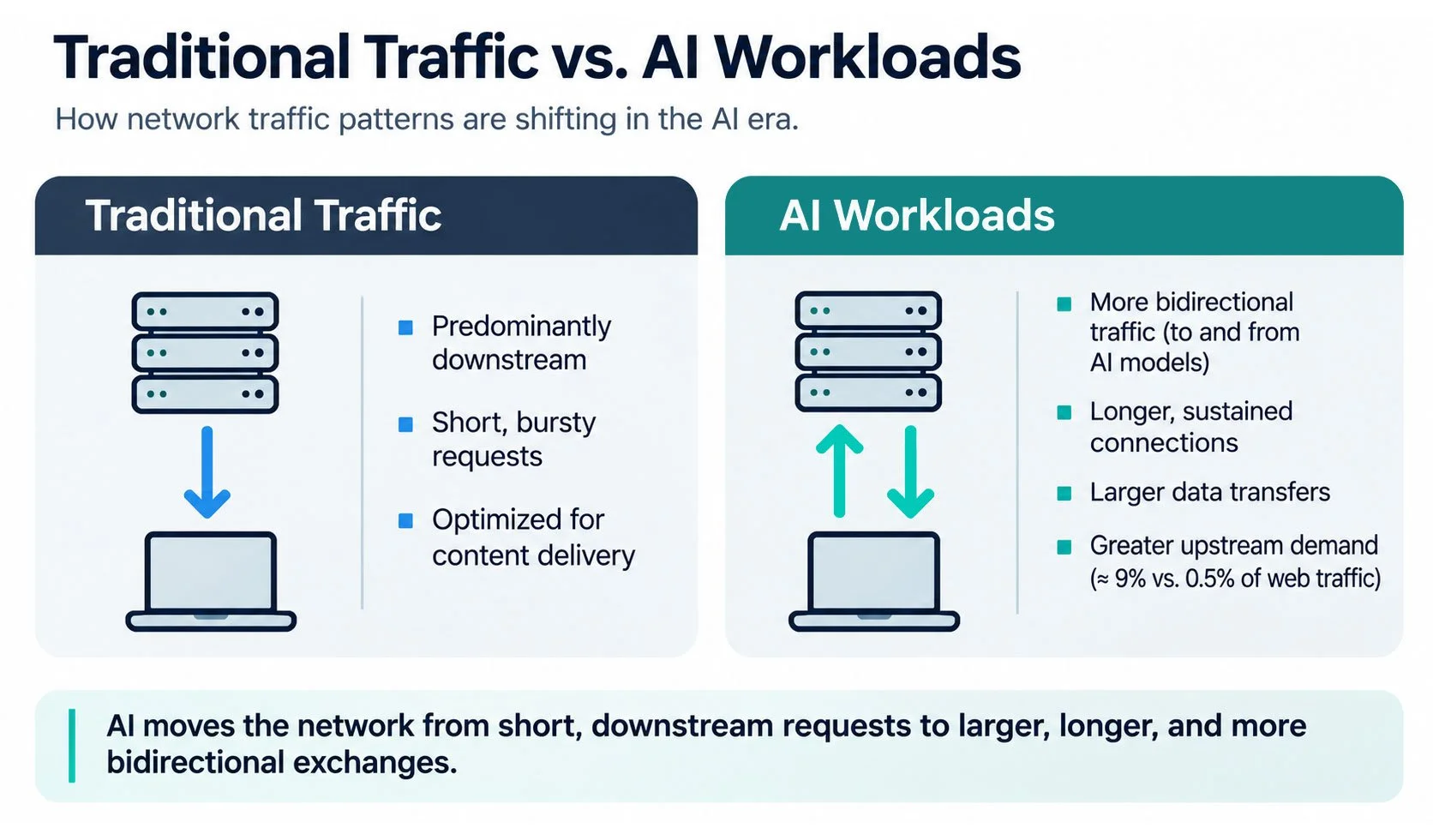
Traditional enterprise networks were largely optimized for downstream delivery. Employees accessed applications, downloaded files, streamed video, and retrieved information from centralized systems.
AI workloads introduce different traffic characteristics.
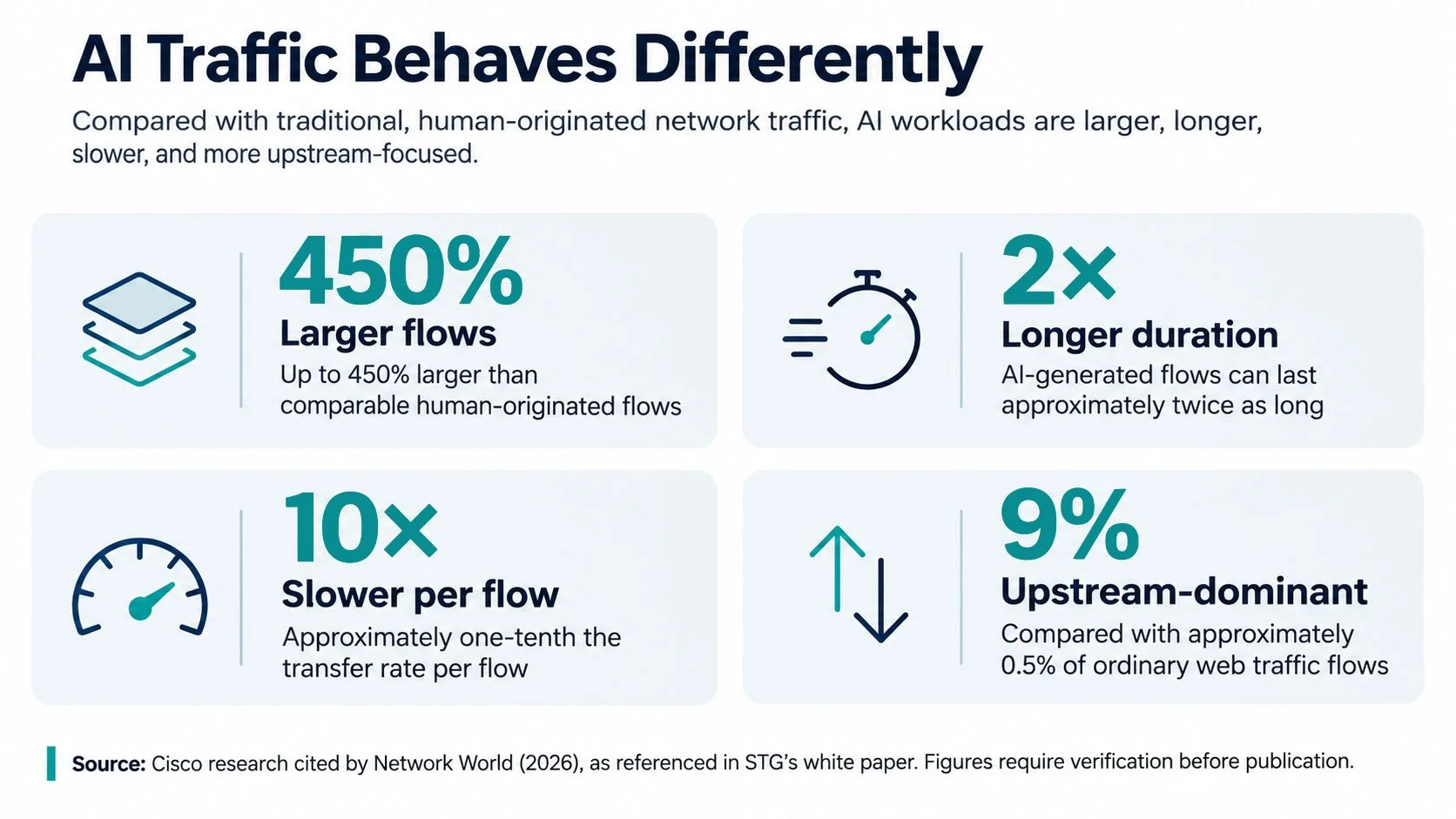
According to Cisco research cited in Network World, AI-generated network flows can be up to 450% larger than comparable human-originated flows. They also last approximately twice as long and transfer data at roughly one-tenth the rate per flow.
Perhaps more significantly, AI introduces substantially more upstream-oriented traffic.
Approximately 9% of AI traffic flows are upstream-dominant, compared with roughly 0.5% of conventional web traffic flows.
This matters because many enterprise networks were designed and provisioned around the assumption that most traffic would travel toward users.
AI changes that balance as enterprise information moves toward models for processing, results return to applications, and additional requests move between interconnected systems.
The result is a more sustained, bidirectional traffic pattern that can expose limitations in existing WAN architectures.
The Scale of the Change
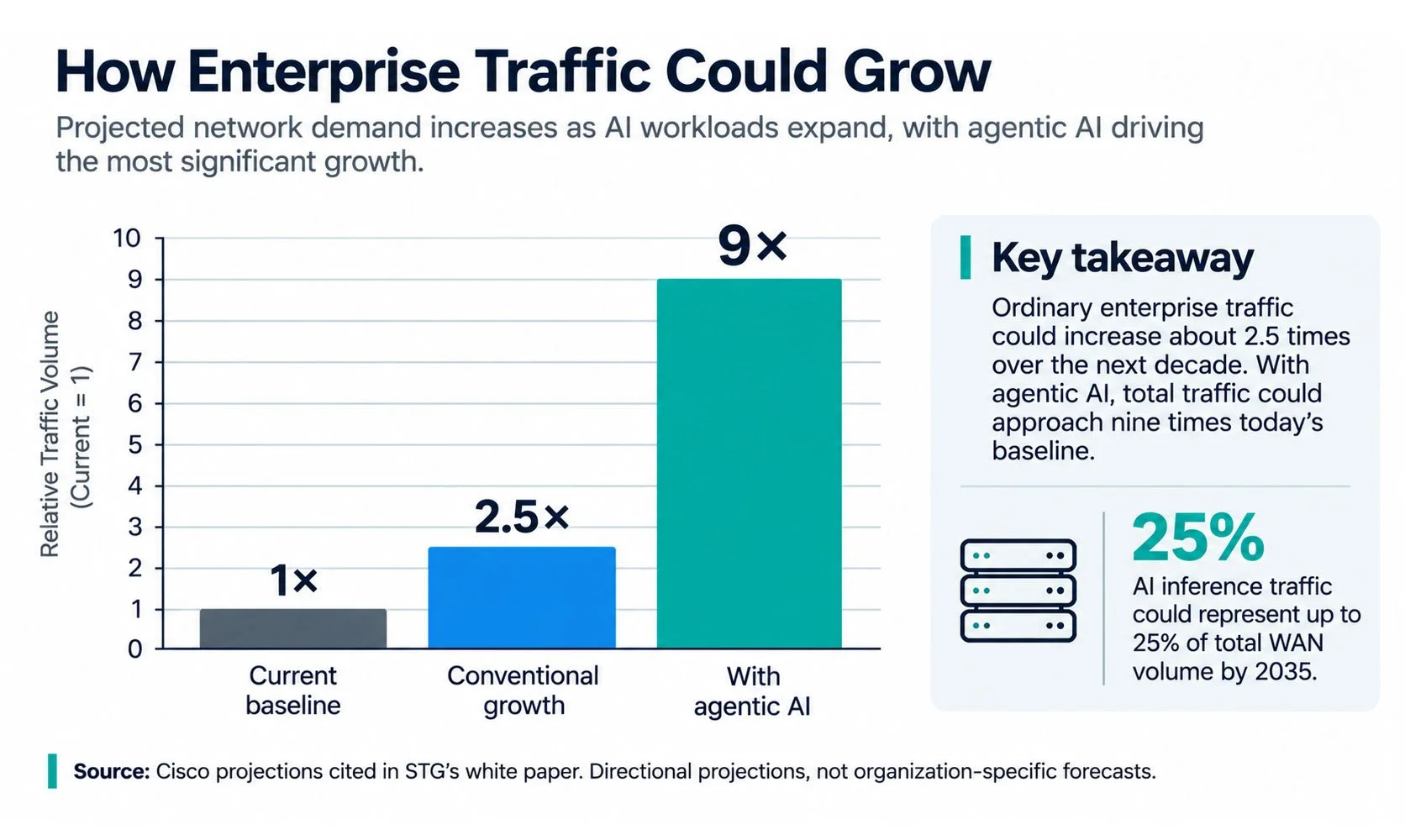
Cisco's projections suggest that ordinary enterprise traffic growth could increase network demand approximately 2.5 times over the next decade. When agentic AI is included, total traffic could approach nine times today's baseline.
AI inference traffic alone could represent as much as 25% of total WAN volume by 2035.
These are industry projections rather than predictions for individual organizations. Actual requirements will depend on the applications deployed, their architecture, and how extensively AI becomes embedded in daily operations.
Nevertheless, the direction is clear: traditional assumptions about enterprise network demand deserve another look.
Four Network Assumptions AI Is Challenging
1. Most Traffic Travels Downstream
Conventional WAN architectures generally prioritize delivering information from centralized applications and cloud environments to end users.
AI workloads can require substantially more information to travel in the opposite direction.
An enterprise AI assistant, for example, may transmit business data to a model, receive a response, and initiate additional requests to complete a task.
Organizations that evaluate network capacity primarily through download performance may overlook emerging upstream constraints.
2. Network Connections Are Short and Bursty
Traditional capacity planning often assumes that network connections are relatively brief.
AI-generated flows can remain active longer, consuming network resources differently from ordinary web requests.
A network capable of handling thousands of short transactions may experience congestion when supporting fewer but longer-running AI interactions.
This distinction becomes especially important as AI applications move beyond isolated pilots and begin operating continuously across an enterprise.
3. Historical Growth Predicts Future Capacity Needs
Many organizations plan network investments using historical utilization, anticipated employee growth, and established application requirements.
AI adoption can change demand much more quickly.
A successful deployment may expand across departments or locations within a single product cycle, creating new capacity requirements well before the next scheduled network upgrade.
The broader infrastructure market is already reflecting this pressure. Industry research cited in STG's white paper indicates that demand for long-haul dark fiber doubled between 2024 and 2025, driven substantially by hyperscale and AI infrastructure expansion.
For enterprises, this suggests that annual capacity reviews and lengthy procurement cycles may be poorly matched to the pace of AI deployment.
4. All AI Applications Have Similar Performance Requirements
AI workloads vary considerably in their sensitivity to latency.
A real-time voice AI agent supporting a customer conversation needs rapid responses to maintain a natural interaction. A document-processing application running overnight can tolerate considerably more delay.
Applying identical network policies to both workloads can create unnecessary expense or compromise application performance.
Organizations need to understand which AI applications require low latency, which can tolerate delays, and how network resources should be allocated accordingly.
What Does an AI-Ready Network Actually Look Like?
There is no single network architecture that will accommodate every organization's AI strategy.
The appropriate approach depends on existing infrastructure, application requirements, geographic distribution, and the pace of deployment.
Several options deserve consideration.
Expanding Existing Network Capacity
Increasing bandwidth can provide additional headroom for growing AI workloads, particularly when organizations anticipate near-term demand.
However, purchasing more capacity does not automatically resolve inefficient traffic routing or upstream congestion. It can also create unnecessary expense if demand develops more slowly than projected.
Using SD-WAN and Intelligent Traffic Management
Software-defined WAN technologies and traffic-engineering capabilities can help organizations classify workloads, prioritize traffic, and dynamically select network paths.
This can be particularly useful for enterprises operating across multiple locations.
The limitation is that better traffic management cannot compensate indefinitely for insufficient underlying capacity.
Establishing Direct Cloud and AI Provider Connections
Dedicated connections to cloud or AI model providers can reduce reliance on public internet routes and potentially improve latency and performance consistency.
These arrangements may be valuable for high-volume, latency-sensitive applications such as real-time voice AI and agent-assist systems.
Technology leaders must also consider provider concentration, resilience, and the operational consequences of becoming dependent on particular interconnection points.
Moving AI Processing Closer to Users
Edge inference allows certain AI workloads to operate closer to the locations where data originates or applications are consumed.
This can reduce WAN traffic and improve responsiveness for latency-sensitive applications.
However, it introduces additional infrastructure, management, and security considerations.
The right choice depends on the workload. Many organizations will ultimately need a combination of approaches.
Network Planning and Data Center Strategy Must Work Together
Network readiness cannot be evaluated independently of the infrastructure running AI applications.
Data center and colocation decisions determine where computing resources are located, while network architecture determines how efficiently users and applications can access them.
A facility may offer attractive power costs, available capacity, and appropriate cooling infrastructure. But if its connectivity cannot support the organization's AI workloads, the infrastructure investment may simply move the performance bottleneck elsewhere.
For that reason, enterprise AI planning should evaluate network connectivity, compute location, latency, and capacity as interconnected decisions.
This becomes increasingly important as organizations assess cloud infrastructure, colocation facilities, and edge deployments.
The Business Risk of an Unprepared Network
Network investment is often evaluated through infrastructure costs, service levels, and utilization.
AI introduces another consideration: the business consequences of applications that perform poorly once deployed at scale.
Consider a customer service organization implementing real-time conversational AI.
The application may perform exceptionally well during a limited pilot. But when usage expands, network congestion or insufficient upstream capacity could introduce delays that undermine the customer experience.
The same concern applies to employee-facing AI assistants, automated workflows, and applications that depend on frequent exchanges with external models.
An AI initiative can appear technically successful while remaining operationally vulnerable.
For CIOs and technology leaders, evaluating network readiness should therefore include the potential cost of degraded application performance, operational disruption, and delayed deployment.
Six Steps Toward an AI-Ready Enterprise Network
Scien Technology Group recommends a vendor-neutral approach that begins with understanding actual requirements before committing to additional technology or capacity.
1. Establish visibility into existing traffic.
Determine whether current monitoring tools can distinguish AI-generated traffic from ordinary application traffic. Understanding actual network behavior provides a stronger foundation for investment decisions.
2. Classify AI workloads by performance requirements.
Identify applications that require low latency and those that can tolerate longer processing times. Network design should reflect these differences.
3. Evaluate upstream capacity explicitly.
Assess upload demand alongside traditional downstream utilization, particularly for applications that exchange substantial amounts of information with external models.
4. Shorten capacity-planning cycles.
Revisit forecasts as AI deployments expand. Quarterly reviews may be more appropriate than relying exclusively on annual infrastructure planning.
5. Assess direct connectivity where appropriate.
Evaluate dedicated cloud and model-provider interconnections for high-volume or latency-sensitive workloads, while accounting for resilience and provider dependencies.
6. Coordinate network and computing infrastructure decisions.
Ensure that data center, colocation, cloud, and edge strategies are developed alongside network planning rather than independently.
These steps help organizations identify potential limitations before they affect production applications.
Preparing the Network for What's Next
Enterprise networks were built around the applications and traffic patterns organizations depended on for decades. Those designs served their purpose, but AI is introducing requirements that traditional capacity models may not adequately anticipate.
As AI adoption expands, network readiness will depend on more than simply increasing bandwidth.
Technology leaders need visibility into emerging traffic patterns, an understanding of application performance requirements, and infrastructure plans that can adapt as workloads evolve.
Organizations that address these questions early will be better positioned to scale AI applications while managing performance, reliability, and investment risk.
Scien Technology Group helps organizations evaluate network readiness, compare infrastructure options, and develop vendor-neutral strategies aligned with their AI initiatives.
To discuss your organization's AI network requirements, visit scientechnologygroup.com.
Research and Further Reading
Cisco, via Network World: AI Workloads Set to Transform Enterprise Networks (2026)
Industry bandwidth research: Long-haul dark fiber demand analysis (2026)
Gartner: Gartner Predicts 40% of Enterprise Apps Will Feature Task-Specific AI Agents by 2026
Scien Technology Group: Top AI Use Cases white paper series, Paper 1, The Network Was Never Built for This